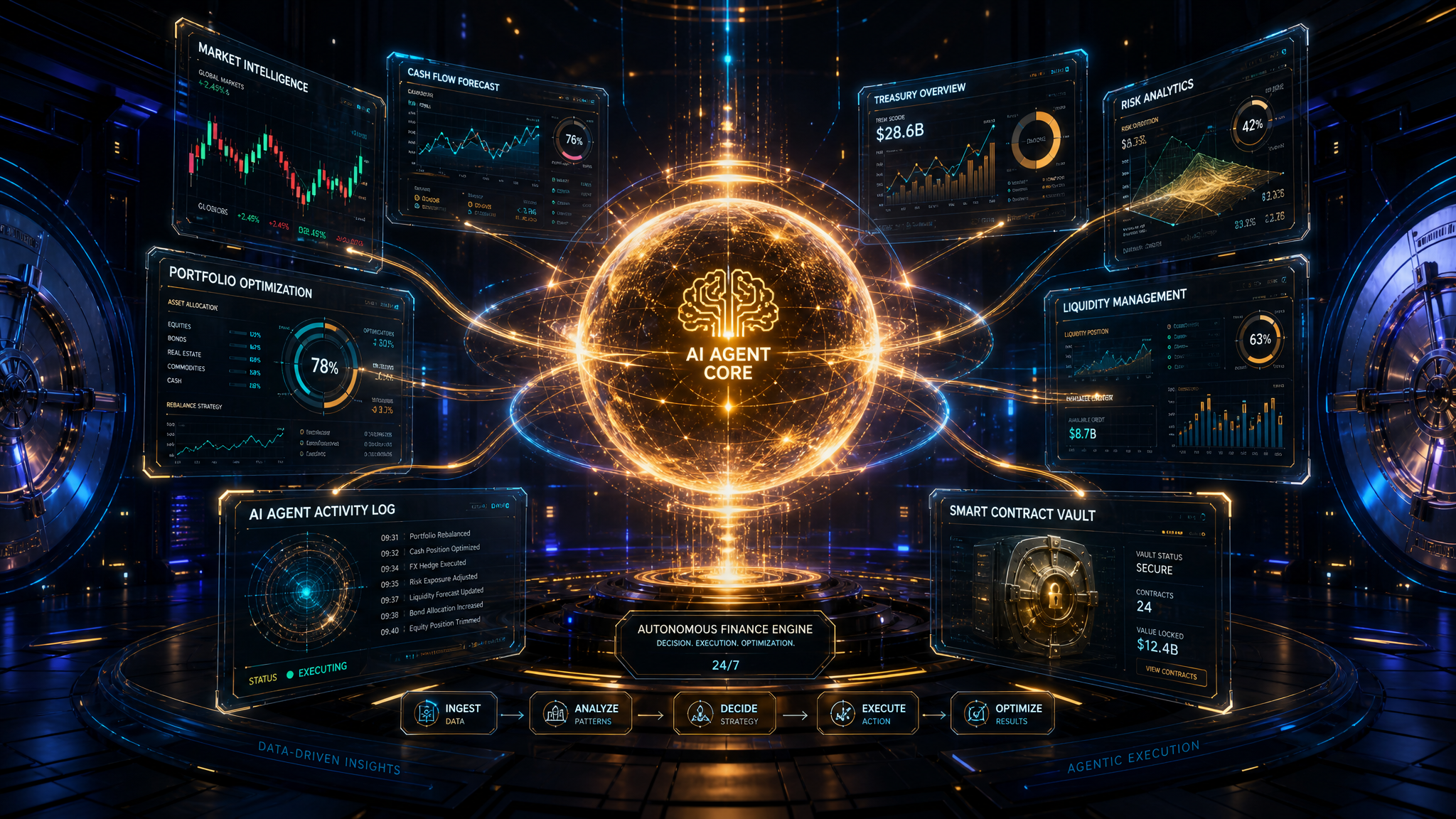
Two years ago, the frontier of AI in finance was generating a variance commentary or drafting an investor update. In 2026, the frontier has moved decisively: autonomous agents are beginning to move money. Cash-flow forecasting, account reconciliation, invoice matching, FX hedging execution, and routine payment runs are increasingly handled by agentic systems that plan, act, and report with minimal human intervention.
For a fractional CFO or a lean finance team, the productivity case is close to overwhelming. Work that consumed days of skilled human attention collapses into minutes of oversight. But the same collapse in friction is exactly what makes the agentic treasury dangerous — and why the real work of 2026 is not adopting the agents but governing them.
What agents can genuinely do now
The frontier has moved decisively: autonomous agents are beginning to move money.
The mature use cases are unglamorous and valuable: continuous reconciliation instead of month-end reconciliation; rolling thirteen-week cash forecasts that update as transactions land; anomaly detection that flags a duplicate or fraudulent payment before it clears; and policy-bound payment execution within pre-approved limits. In each case the agent is not being creative — it is being tireless, consistent, and fast.
Where it breaks
The failure modes are not the ones science fiction warns about. They are mundane and financial. An agent that misreads an ambiguous instruction can move a real balance. An agent granted broad credentials becomes a concentrated attack surface. An agent optimising a narrow objective can take a locally rational action with a globally damaging result. And an agent whose reasoning is opaque makes after-the-fact audit painful precisely when audit matters most.
Adopt agentic finance where errors are cheap and reversible — and never automate faster than the control architecture can absorb.
The control architecture that actually works
The organisations deploying agentic treasury safely share a pattern. They scope authority tightly — agents act within hard, externally enforced limits, not limits they could reason their way around. They separate proposal from execution — an agent may prepare a payment run, but a second control (human or independent system) authorises the actual transfer above a threshold. They log every action immutably, so that reconstruction is always possible. And they treat agent credentials as the crown jewels, rotating and constraining them as aggressively as any privileged human access.
The steward's judgement call
The temptation is to wait for the governance frameworks to mature before adopting. That is the wrong lesson. The correct posture is to adopt agentic finance now, in the low-stakes, high-volume operations where errors are cheap and reversible, while building the oversight muscle before extending agents to consequential, irreversible actions. The firms that wait will be out-run on cost; the firms that rush without controls will be the cautionary tales. The steward's edge is in the disciplined middle — automating aggressively, but never faster than the control architecture can absorb.