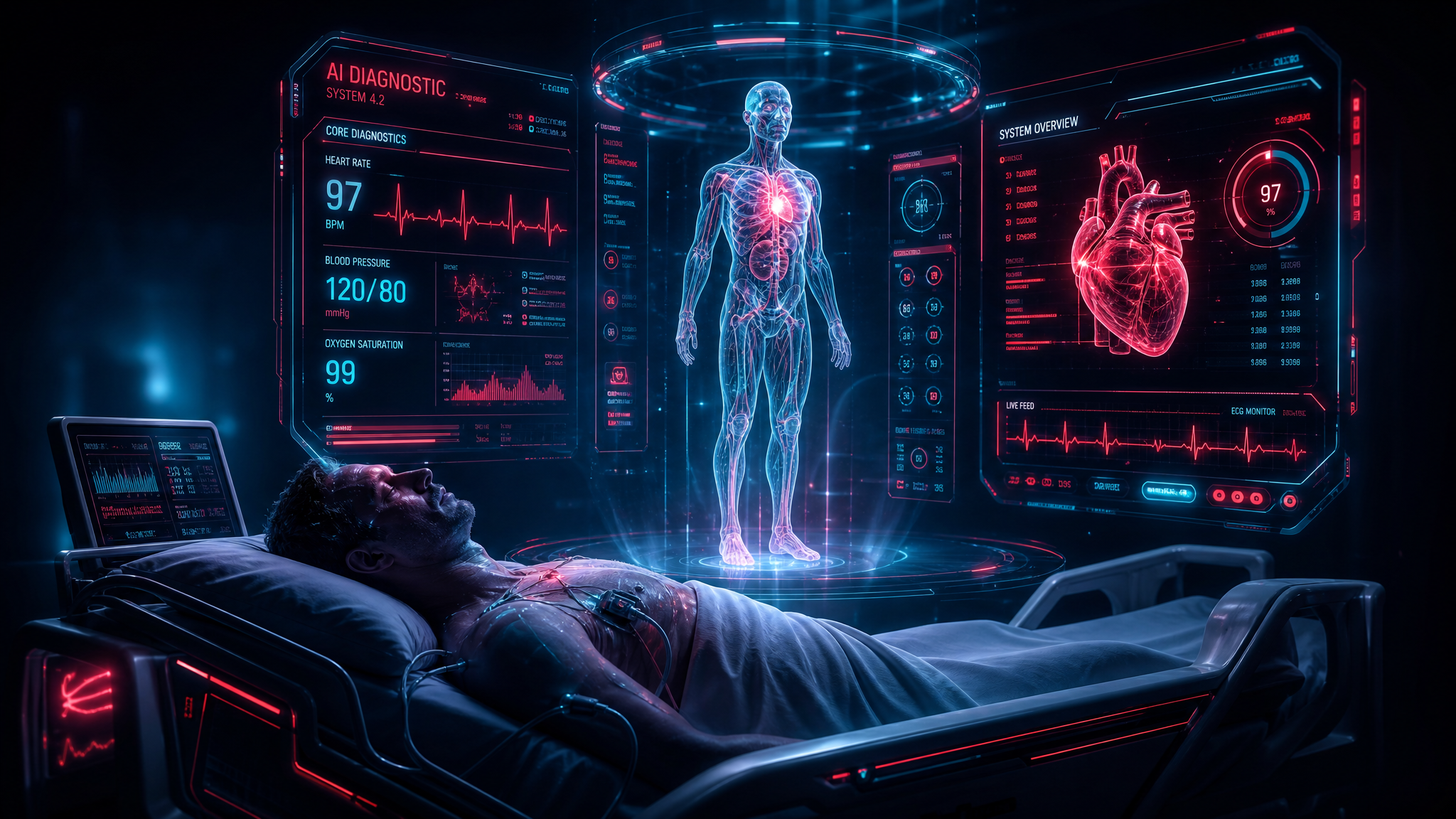
AI diagnostic systems have crossed a threshold that would have seemed distant only a few years ago. In narrow, well-defined tasks — reading certain scans, flagging specific patterns, triaging particular presentations — they now match and sometimes exceed experienced clinicians. For the Guardians tribe, this is a genuine frontier signal. But the interesting questions have moved past accuracy.
Augmentation, not replacement
The mature framing emerging in serious clinical settings is not machine versus clinician but machine plus clinician. The AI surfaces patterns, flags anomalies, and handles high-volume screening; the human provides context, exercises judgement in ambiguous cases, and carries the relationship with the patient. The combination consistently outperforms either alone. The frontier is a redesign of the care workflow, not a substitution of the caregiver.
The frontier is a redesign of the care workflow, not a substitution of the caregiver.
The problems that actually remain
The unsolved questions are not primarily technical. Liability: when an augmented diagnosis errs, who is responsible — the clinician who deferred, the clinician who overrode, or the system's maker? The law is unsettled and practitioners are exposed in the gap. Trust: patients and clinicians must calibrate how much to rely on a system that is usually right but occasionally, confidently wrong. Automation bias: the risk that a clinician stops thinking critically because the machine is usually correct is real and documented.
What a Guardian should do at this frontier
At the bedside, accuracy was never the whole of care, and it never will be.
The operator-ready posture is informed adoption with retained judgement. Practitioners who learn to use these tools as instruments — understanding their failure modes, maintaining their own diagnostic skill, and staying accountable for the final call — capture the benefit without surrendering the responsibility that defines their role. Those who either reject the tools outright or defer to them uncritically are both mismanaging the frontier.
The signal, read forward
Clinical AI will keep improving, and the pressure to adopt will intensify as augmented care demonstrably improves outcomes. The Guardians who thrive will be those who treat the machine as a powerful instrument in a fundamentally human practice — because at the bedside, accuracy was never the whole of care, and it never will be.