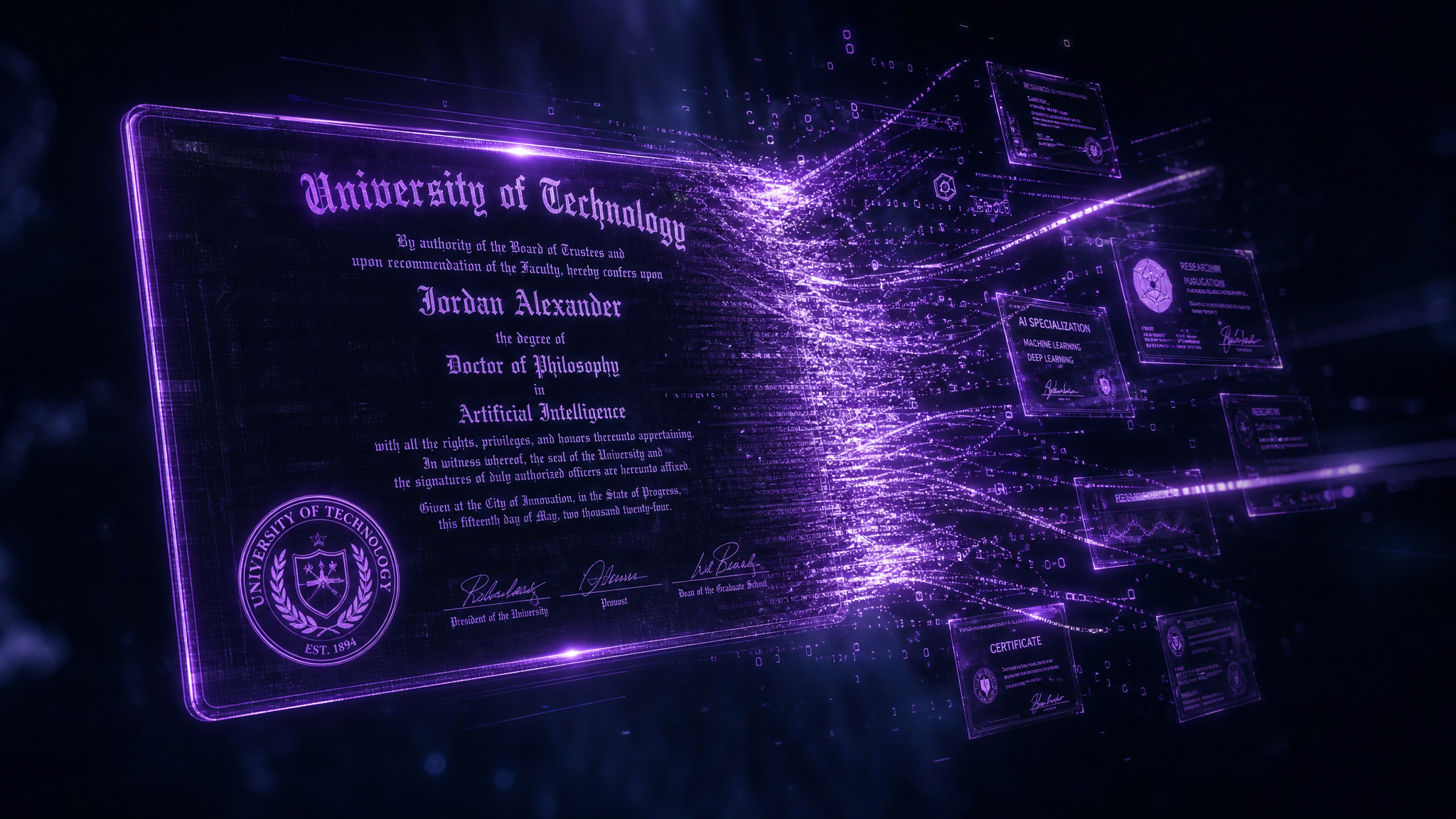
For a century, the credential did two jobs at once. It certified that a person had absorbed a body of knowledge, and it signalled that fact to employers, clients, and institutions who had no cheap way to verify it themselves. Those two jobs are now coming apart.
AI-native learning has collapsed the time it takes to reach working competence in a domain. A motivated learner with an adaptive tutor can now traverse in months what a degree stretched across years — and can do so with continuous, granular assessment that a final exam never offered. The knowledge half of the credential is being commoditised. What remains scarce, and therefore valuable, is trustworthy proof of competence.
Why this is a power question, not a training question
The knowledge half of the credential is being commoditised. What remains scarce is trustworthy proof of competence.
Accreditation has always been an exercise of power. The body that decides what counts as qualified controls entry to a profession, sets the price of that entry, and captures the rents. As AI erodes the knowledge-transfer monopoly of universities and certifying bodies, the contest moves to a new terrain: who operates the layer that verifies capability in a world where anyone can learn anything quickly.
Three contenders are emerging. Incumbent accreditors are racing to attach themselves to micro-credentials and continuous assessment. Platforms are building portable, verifiable skill records tied to real work product. And a long tail of independent experts are simply publishing their outcomes in the open, letting demonstrated results serve as their credential.
What a member of the Experts tribe should do
In a collapsing-credential world, the person who issues the new proof wins.
The operator-ready move is to build a portfolio of verifiable outcomes that a client can inspect without trusting an intermediary. A coach who can point to measured client results, an advisor who can show a track record, an author whose frameworks are demonstrably adopted — these are becoming stronger signals than any letters after a name.
The second move is to own the assessment relationship. The expert who defines what mastery looks like in their niche, and who certifies it credibly, captures the power that the eroding accreditors are shedding. In a collapsing-credential world, the person who issues the new proof wins.
The uncomfortable implication
Decoupling capability from credential is liberating for the genuinely skilled and threatening for those whose authority rested on the certificate rather than the competence. The Experts tribe sits precisely on that fault line. The winners will treat the collapse not as a loss of gatekept status but as an opening to compete on the only thing that survives it: proven, inspectable mastery.