When Two Exponentials Collide
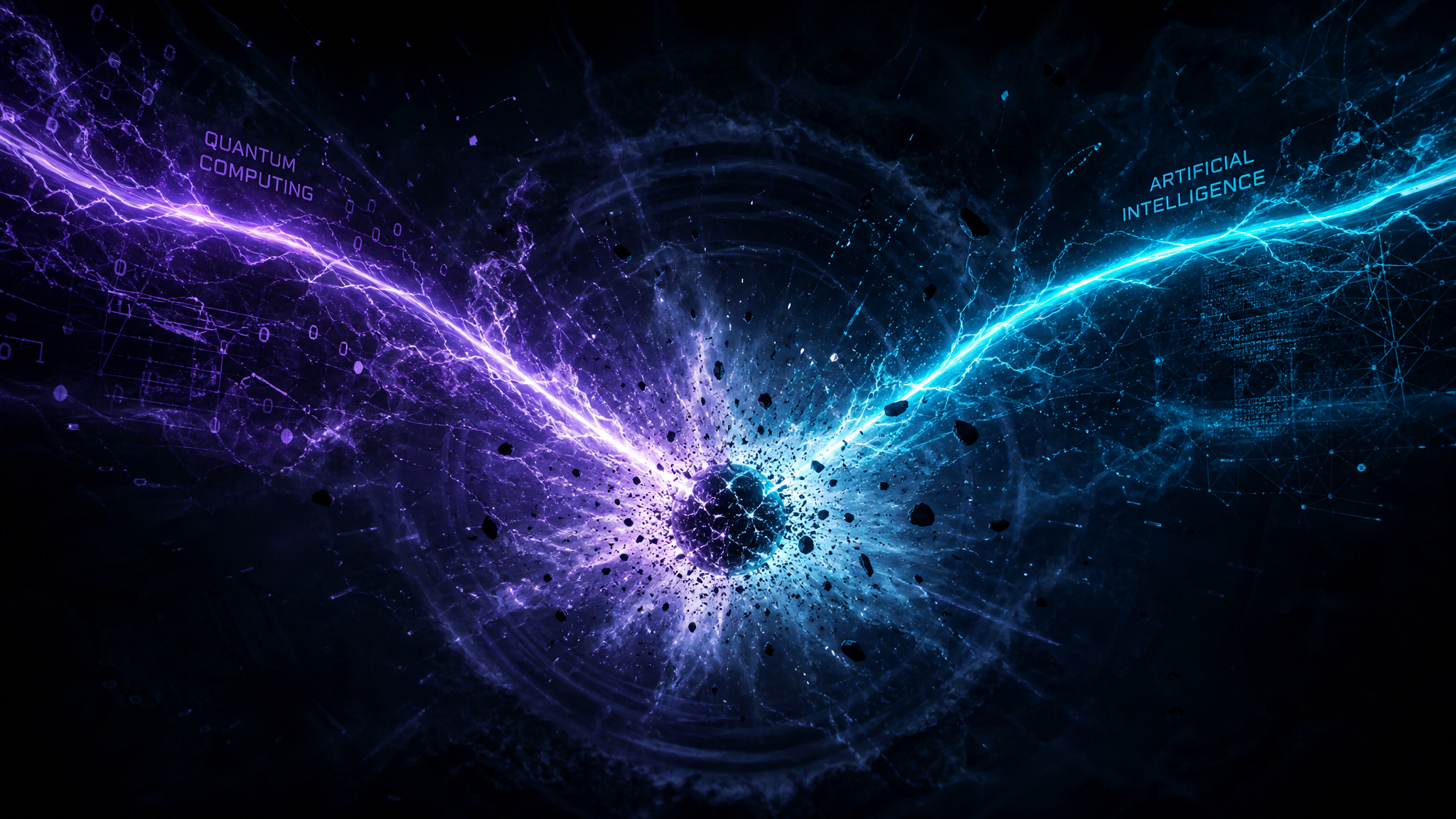
Quantum computing and artificial intelligence are each, individually, among the most powerful technologies ever developed. Quantum computing threatens the mathematical foundations of modern encryption. Artificial intelligence can find vulnerabilities in code and protocols at superhuman speed. Separately, each poses significant challenges to the security infrastructure on which modern civilisation depends.
Combined, they represent the most potent cryptanalytic capability ever conceived.
This is not hyperbole. It is the assessment of the National Security Agency, which has mandated that all National Security Systems migrate to post-quantum cryptography by 2035. It is the assessment of NIST, which has spent seven years developing and standardising quantum-resistant cryptographic algorithms. And it is the assessment of every major intelligence agency on Earth, all of which are engaged in what may be the most consequential silent arms race in human history.
The race is silent because the weapon is invisible. The attacks are happening now. They just won't be completed until later.
The Quantum Threat to Encryption: A Primer
Modern digital security rests on a small number of mathematical assumptions. The two most important:
RSA encryption relies on the assumption that factoring large numbers is computationally intractable. A 2048-bit RSA key would take a classical computer approximately 300 trillion years to break by brute force. This is what makes online banking, secure communications, and digital signatures possible.
Elliptic Curve Cryptography (ECC) relies on the assumption that computing discrete logarithms on elliptic curves is computationally intractable. ECC provides the same security as RSA with smaller key sizes, making it the standard for mobile devices, IoT, and modern TLS implementations.
Both assumptions are correct — for classical computers. Shor's algorithm, discovered by mathematician Peter Shor in 1994, demonstrates that a sufficiently powerful quantum computer can factor large numbers and compute discrete logarithms in polynomial time. What takes a classical computer 300 trillion years, a quantum computer could accomplish in hours.
The caveat is "sufficiently powerful." Running Shor's algorithm to break RSA-2048 requires approximately 4,000 logical qubits — each composed of thousands of physical qubits for error correction. Current quantum computers have approximately 1,100 physical qubits (IBM Condor) with error rates that preclude running Shor's algorithm at meaningful scale. The timeline for a "cryptographically relevant quantum computer" (CRQC) — one capable of breaking RSA-2048 — is the subject of intense debate, with estimates ranging from 2030 to 2045.
But here is the critical insight that transforms this theoretical timeline into an immediate operational threat: you don't need a quantum computer today to exploit quantum decryption tomorrow.
Harvest Now, Decrypt Later: The Breach in Reverse
The "Harvest Now, Decrypt Later" (HNDL) strategy is breathtakingly simple: intercept and store encrypted data today, wait for quantum computers capable of decrypting it, then read everything at leisure.
The NSA has mandated that all National Security Systems migrate to post-quantum cryptography by 2035. Most organisations haven't started.
The economics are compelling. Storage costs have fallen to approximately $0.01 per gigabyte per month for archival storage. A nation-state intercepting encrypted internet traffic can store petabytes of data for a few million dollars annually — a rounding error in an intelligence budget. The data remains encrypted and useless today. But when a CRQC becomes available, every intercepted communication, every encrypted file transfer, every VPN tunnel becomes readable.
The implications are immediate for any data whose sensitivity outlives the timeline to quantum decryption:
- Diplomatic communications: Treaties, negotiations, and intelligence assessments that remain classified for decades
- Medical records: Patient data protected by regulations that mandate confidentiality in perpetuity
- Intellectual property: Trade secrets, research data, and proprietary algorithms whose commercial value persists for years
- Financial data: Transaction records, investment strategies, and risk models that could be exploited retroactively
- Personal communications: Private messages and documents that individuals expect to remain confidential
Intelligence agencies have explicitly confirmed that HNDL campaigns are underway. The Cloud Security Alliance's 2026 report on post-quantum threats notes that "nation-state actors are already harvesting encrypted data at scale, targeting diplomatic, military, and economic communications." The data being collected today is a future intelligence asset of incalculable value.
Enter AI: The Vulnerability Multiplier
Quantum computing's threat to encryption is well-understood, if often discussed in isolation. The convergence with artificial intelligence creates a qualitatively different threat landscape.
AI-Accelerated Vulnerability Discovery
AI systems can analyse code, protocols, and cryptographic implementations at speeds and scales impossible for human researchers. Modern AI code analysis tools can scan millions of lines of code for vulnerability patterns, identify subtle implementation flaws, and discover side-channel attacks that would take human researchers months or years to find.
Applied to cryptographic systems, AI vulnerability discovery has several implications:
Implementation attacks: Even quantum-resistant algorithms can be broken if their implementations contain flaws. AI can systematically analyse cryptographic implementations for timing attacks, power analysis vulnerabilities, and other side-channel weaknesses that bypass the mathematical security of the algorithm itself.
Protocol analysis: Cryptographic protocols — the multi-step procedures that use encryption algorithms to achieve security goals — are often more vulnerable than the underlying algorithms. AI can analyse protocol specifications to identify logical flaws, race conditions, and composition weaknesses that compromise security even when individual algorithms are sound.
Key management attacks: The most common failure mode in cryptographic systems is not the algorithm but the key management — how keys are generated, distributed, stored, and retired. AI can identify patterns in key management practices that reveal exploitable weaknesses, from predictable random number generators to insecure key storage mechanisms.
AI-Enhanced Cryptanalysis
Beyond vulnerability discovery, AI is being applied to cryptanalysis itself — the mathematical process of breaking encryption:
Pattern recognition in ciphertext: While brute-force decryption of properly implemented modern encryption is infeasible even for AI, AI can identify statistical patterns in encrypted data that reveal information about the plaintext. This is particularly effective against encryption schemes that are slightly weakened by implementation choices or legacy compatibility requirements.
Harvest Now, Decrypt Later is a breach that happens in reverse. The attacks are happening now. They just won't be completed until later.
Side-channel exploitation: AI can process side-channel data — power consumption, electromagnetic emissions, timing variations — to extract cryptographic keys from hardware implementations. Machine learning models trained on side-channel data have demonstrated the ability to extract full AES keys from smart cards with fewer traces than traditional differential power analysis.
Hybrid classical-quantum attacks: AI can optimise the use of limited quantum resources by identifying which parts of a cryptanalytic problem benefit most from quantum processing. This could enable effective attacks with quantum computers significantly smaller than the theoretical minimum required for a pure quantum attack.
The Convergence Threat
The combined quantum-AI threat is greater than the sum of its parts:
1. AI identifies weaknesses in cryptographic implementations and protocols 2. Quantum computing provides the computational capability to exploit those weaknesses 3. AI optimises the quantum attack, reducing the hardware requirements 4. HNDL archives provide the target data, pre-collected and waiting
This four-step chain transforms the quantum threat from a future theoretical concern to a present operational reality. The quantum computer that breaks encryption doesn't need to exist yet — the AI that finds the vulnerabilities and the storage that holds the harvested data already do.
The NIST Post-Quantum Migration: Too Little, Too Late?
The National Institute of Standards and Technology (NIST) has been working on post-quantum cryptography (PQC) since 2016. In August 2024, NIST finalised three PQC standards:
- FIPS 203 (ML-KEM): A key encapsulation mechanism based on module lattice problems, replacing RSA and ECC for key exchange
- FIPS 204 (ML-DSA): A digital signature algorithm based on module lattice problems, replacing RSA and ECDSA for signatures
- FIPS 205 (SLH-DSA): A stateless hash-based digital signature algorithm, providing a backup signature scheme based on different mathematical assumptions
These standards are mathematically sound — no efficient quantum attack is known against lattice-based or hash-based cryptographic schemes. The problem is not the standards themselves but the migration timeline.
The Migration Gap
NIST has proposed deprecating RSA-2048 and ECC P-256 in new deployments by 2030, with a full ban by 2035. The NSA's CNSA 2.0 suite requires new acquisitions to support quantum-safe algorithms starting January 2027.
But migrating cryptographic infrastructure is not like updating software. It requires:
- Cryptographic inventory: Identifying every system, protocol, and implementation that uses vulnerable algorithms. Most large organisations have thousands of cryptographic dependencies, many undocumented.
- Compatibility testing: Ensuring that new algorithms work with existing systems, protocols, and hardware. PQC algorithms have different performance characteristics than RSA and ECC — larger key sizes, different latency profiles, and different computational requirements.
- Staged deployment: Rolling out new algorithms in a way that maintains interoperability with partners, customers, and legacy systems during the transition.
- Validation: Verifying that the new implementations are correct and free from the implementation vulnerabilities that AI-enhanced analysis can exploit.
Estimates for full PQC migration in a large enterprise range from 5 to 15 years. For critical infrastructure — power grids, financial systems, healthcare networks — the timeline is even longer due to legacy hardware that cannot be software-updated and regulatory requirements that mandate extended testing.
AI identifies the weakness. Quantum exploits it. HNDL stores the target data. The quantum computer that breaks encryption doesn't need to exist yet.
The arithmetic is stark: if a CRQC arrives by 2032 (a mid-range estimate), organisations that begin migration in 2026 have approximately 6 years to complete a process that may take 15. The gap between the threat timeline and the migration timeline is the most dangerous window in the history of information security.
The AI Infrastructure Vulnerability
The quantum-AI threat extends to AI systems themselves, creating a recursive vulnerability:
Model Weight Theft
Frontier AI models represent billions of dollars of training investment. Model weights transmitted between data centres are encrypted with standard algorithms vulnerable to quantum attack. Under HNDL, model weights intercepted today could be decrypted when a CRQC becomes available, enabling the replication of proprietary AI capabilities.
Training Data Exposure
AI models are trained on datasets that often contain sensitive information — personal data, proprietary content, classified information. Encrypted training data pipelines are vulnerable to the same HNDL attacks that target other encrypted communications.
Agent-to-Agent Communication
The proliferation of agentic AI architectures — systems where AI agents communicate with each other to accomplish tasks — creates dense networks of encrypted machine-to-machine communications. These communications are protected by the same cryptographic primitives that quantum computing threatens. An adversary who can decrypt agent-to-agent communications can not only read the content but potentially inject instructions that manipulate the agent network's behaviour.
Supply Chain Integrity
Digital signatures are used to verify the provenance of software packages, model weights, and training data. A quantum computer capable of forging digital signatures could insert backdoored components into AI supply chains — compromising the integrity of AI systems at a level that would be nearly impossible to detect.
A Cryptographic Bill of Materials
The first step in addressing the quantum-AI threat is understanding your exposure. The concept of a "Cryptographic Bill of Materials" (CBOM) — a comprehensive inventory of all cryptographic dependencies in an organisation's systems — is gaining traction as a governance requirement:
A CBOM should include:
- Every algorithm in use (RSA, ECC, AES, SHA-256, etc.)
- Key sizes and configurations
- Protocol dependencies (TLS versions, VPN implementations, certificate authorities)
- Hardware cryptographic modules and their firmware versions
- Third-party dependencies that include cryptographic components
- Data classification by sensitivity duration (how long does this data need to remain confidential?)
If a cryptographically relevant quantum computer arrives by 2032, organisations beginning migration in 2026 have 6 years to complete a 15-year process.
Organisations that do not know their cryptographic dependencies cannot protect them. And most organisations, including many that handle extremely sensitive data, have never conducted a comprehensive cryptographic inventory.
Hybrid Cryptography: The Bridge
The recommended near-term mitigation is hybrid cryptography: deploying new PQC algorithms alongside existing classical algorithms, so that security is maintained even if one of the algorithms is broken.
A hybrid TLS handshake, for example, would negotiate both a classical key exchange (using ECC) and a post-quantum key exchange (using ML-KEM). The resulting session key would be derived from both exchanges, ensuring that the connection is secure against both classical and quantum attacks.
Hybrid approaches add computational overhead and complexity, but they provide the strongest available protection during the transition period. Several major cloud providers have begun deploying hybrid cryptography for internal communications, and the Internet Engineering Task Force (IETF) is developing standards for hybrid key exchange in TLS 1.3.
The Society OS Response: Sovereign Cryptographic Governance
The quantum-AI cryptanalytic threat has direct implications for Society OS's governance architecture.
The Sovereign Stack and Quantum Readiness
The Sovereign Stack framework — which specifies the infrastructure layers necessary for AI-era national sovereignty — must include quantum-resistant cryptography as a foundational requirement. A nation that builds sovereign AI infrastructure on vulnerable cryptographic foundations is building on sand — the sovereignty is illusory because the infrastructure can be compromised by any adversary with quantum capability.
Society OS's specification for the Sovereign Stack includes a "cryptographic sovereignty" layer that requires:
- All communications encrypted with PQC algorithms or hybrid schemes
- Cryptographic agility — the ability to swap algorithms without system redesign
- Key management infrastructure that is quantum-resistant end-to-end
- Regular cryptographic audits validated through the Dark Mesh Consensus mechanism
SAFE-VOID and Quantum Cryptanalysis
Quantum cryptanalysis falls clearly within VOID territory under Society OS's boundary framework. The ability to break encryption — whether used to access personal communications, compromise critical infrastructure, or steal intellectual property — is a capability that fundamentally undermines individual and collective sovereignty.
The SAFE-VOID boundary for quantum cryptanalysis is absolute: no entity should possess the capability to break encryption without governance constraints that are structurally enforceable. This does not mean that quantum cryptanalysis research should be prohibited — understanding the threat is essential to defending against it. But the deployment of cryptanalytic capabilities must be subject to governance mechanisms that prevent abuse.
The 42 Pillars and Digital Privacy
Every day of delay is a day's worth of encrypted data added to the archive. That data cannot be unintercepted.
The 42 Pillars of Existence include explicit provisions for what Society OS terms "communicative sovereignty" — the right of individuals and communities to communicate privately without surveillance by state or corporate actors. The quantum-AI threat to encryption is a direct threat to communicative sovereignty, and the failure to migrate to quantum-resistant cryptography is, in this framework, a governance failure with constitutional implications.
The H-T-A Protocol requires that any AI system with potential cryptanalytic applications undergo alignment verification that specifically assesses the system's impact on communicative sovereignty. This includes AI systems designed for defensive purposes (vulnerability scanning, penetration testing) as well as offensive applications, because the same capabilities that defend can be turned to attack.
Guardian Swarms and Quantum Threat Detection
The Guardian Swarm architecture includes provisions for monitoring the global quantum threat landscape — tracking quantum hardware development, identifying potential HNDL campaigns, and alerting sovereign participants to quantum-specific threats. The decentralised nature of the Guardian Swarm makes it resistant to the kind of centralised compromise that could blind a traditional intelligence agency to quantum threats.
The Timeline of Urgency
The quantum-AI cryptanalytic threat operates on a timeline that demands immediate action despite uncertain deadlines:
Now (2026): HNDL campaigns are active. Every encrypted communication sent today using RSA or ECC is a potential future intelligence asset. AI vulnerability discovery tools are finding weaknesses in cryptographic implementations at scale.
Near-term (2027-2030): NIST deprecation timelines take effect. Organisations that have not begun PQC migration face increasing regulatory and security risk. Quantum hardware continues to advance, with the first demonstrations of quantum advantage in specific cryptanalytic subtasks expected.
Medium-term (2030-2035): The window during which a CRQC may become available. Organisations that have not completed migration face existential risk to their encrypted data. The HNDL archive becomes decryptable.
Long-term (2035+): The post-quantum era, in which PQC is standard and quantum-vulnerable cryptography is legacy. Organisations that migrated early are secure. Those that did not have already been compromised — they just don't know it yet.
The key insight is that the damage is being done now, even though the exploitation will occur later. Waiting for a CRQC to arrive before beginning migration is like waiting for a fire to start before installing fire alarms. The threat model is retroactive: tomorrow's quantum computer decrypts today's data.
Every day of delay is a day's worth of encrypted data added to the HNDL archive. That data cannot be unintercepted. Once it is collected, the only safeguard is ensuring it was encrypted with algorithms that quantum computers cannot break.
The clock is not ticking toward a future deadline. It has been ticking since the first HNDL campaign began.
And nobody knows exactly when it started.
This article is part of the Sovereign Intelligence Hub's quantum security series. For the cryptographic foundations under threat, see [The Quantum Threat to Encryption](/hub/quantum-threat-to-encryption). For the broader quantum-AI convergence driving these capabilities, see [Quantum-AI Convergence](/hub/quantum-ai-convergence). For why data sovereignty is the first line of assurance, see [Data Sovereignty](/hub/data-sovereignty-nation-state).
Sources & Further Reading
- 1.NIST Post-Quantum Cryptography Standards: FIPS 203, 204, 205 (August 2024)
- 2.Cloud Security Alliance: AI Infrastructure Post-Quantum HNDL Threat Report 2026
- 3.NSA CNSA 2.0 Suite: Post-Quantum Cryptography Requirements for National Security Systems
- 4.Palo Alto Networks: Harvest Now, Decrypt Later — HNDL Threat Analysis
- 5.ResearchGate: A Time-Dependent Threat Model for Post-Quantum Migration, 2025
- 6.Quantum Zeitgeist: Top Post-Quantum Cryptography Companies 2026
- 7.Shor, P.W., 'Algorithms for Quantum Computation: Discrete Logarithms and Factoring', FOCS 1994
- 8.IBM Condor 1,121-Qubit Processor: Technical Specifications and Roadmap
- 9.IETF: Hybrid Key Exchange Standards for TLS 1.3 Post-Quantum Migration
- 10.Society OS: Sovereign Stack — Cryptographic Sovereignty Layer Specification
- 11.Society OS: SAFE-VOID Boundaries for Quantum Cryptanalytic Capabilities
- 12.Society OS: Guardian Swarm Quantum Threat Monitoring Architecture